Stock Market Education for Beginners: A Step-by-Step Guide
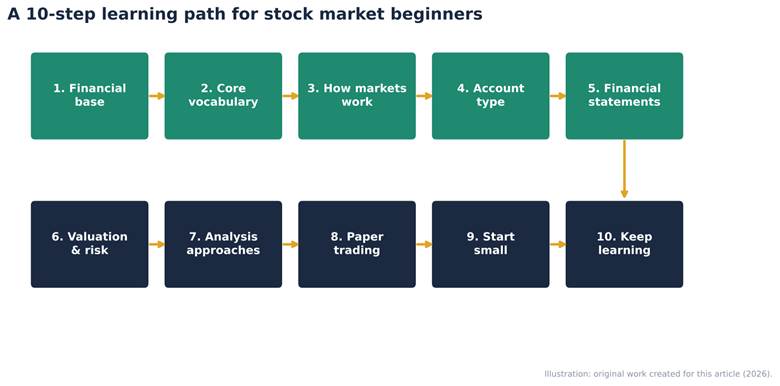
Figure: Flow diagram of a ten-step stock market learning path for beginners. Original illustration created for this article.
Stock Market Education for Beginners: A Step-by-Step Guide
Short answer: The most effective way to learn the stock market is to follow a sequence: secure your personal finances, learn how markets and orders work, understand company financial statements, study basic valuation and risk, practise with a paper-trading account, then invest small real amounts while keeping a journal. Free resources from regulators such as the US SEC's Investor.gov and SEBI, plus broker learning centres, cover most of what a beginner needs. Paid courses and credentials become useful once you know which direction you want to go.
This guide sets out a ten-step path that you can complete over roughly three to six months, depending on how much time you invest each week.
Step 1: Build Your Financial Base First
Before learning about stocks, make sure you have an emergency fund, manageable debt and clear goals. Money you may need within the next few years generally should not be in equities. Investing with money you cannot afford to see fall leads to panic selling.
Step 2: Learn the Core Vocabulary
Start with the terms you will see every day: shares, dividends, market capitalisation, index, ETF, mutual fund, bid and ask, spread, volatility and diversification. Investor.gov's glossary and SEBI's investor education pages explain these in plain language at no cost.
Step 3: Understand How Markets Work
Learn what stock exchanges do, how orders are matched and why prices move. Key concepts include:
- Primary vs secondary markets: companies raise money in IPOs; investors trade afterwards.
- Order types: market, limit, stop-loss and stop-limit orders.
- Settlement: in India, equity trades settle on a T+1 basis, and the US moved to T+1 in 2024.
- Regulators: the SEC and FINRA in the US; SEBI in India.
Step 4: Choose the Right Account Type
| Account | Market | Purpose |
| Cash brokerage account | US | Buy and sell with your own money; best for beginners |
| Margin account | US | Borrow from the broker; adds risk |
| Retirement account (IRA) | US | Tax-advantaged long-term investing |
| Demat + trading account | India | Hold shares electronically and place orders |
Beginners should start with a cash account or a standard demat account and avoid margin and derivatives until they understand the risks.
Step 5: Learn to Read Financial Statements
Companies publish three core statements:
- Income statement: revenue, expenses and profit.
- Balance sheet: assets, liabilities and shareholders' equity.
- Cash flow statement: where cash actually came from and went.
US company filings are free on the SEC's EDGAR system; Indian companies publish annual reports on the NSE and BSE websites and their own investor pages. Pick one company you know well and read its latest annual report section by section.
Step 6: Study Basic Valuation and Risk
Learn a few simple ratios before anything complex:
| Metric | What it tells you |
| Price-to-earnings (P/E) | How much investors pay for each unit of profit |
| Price-to-book (P/B) | Price relative to net assets |
| Return on equity (ROE) | How efficiently a company uses shareholder capital |
| Debt-to-equity | How much a company relies on borrowing |
| Dividend yield | Annual dividend relative to share price |
At the same time, learn why diversification and position sizing matter more than any single stock pick.
Step 7: Explore Analysis Approaches
Read the basics of both fundamental analysis (business quality and valuation) and technical analysis (price and volume patterns). Most long-term investors rely mainly on fundamentals; short-term traders lean on technicals. Understanding both helps you judge claims you see online.
Step 8: Practise With Paper Trading
Simulators let you place trades with virtual money. Schwab's thinkorswim, for example, includes paperMoney, which uses live market data with hypothetical funds. Set a rule: trade on paper for at least four to six weeks and record why you made each decision.
Step 9: Start Small With Real Money
Move a small amount you are comfortable risking into a diversified index fund or ETF first. Add individual stocks only after you can explain the business, the valuation and what would make you sell. Keep a trading journal that records your reasoning, entry, exit and emotions.
Step 10: Keep Learning and Consider Credentials
Once comfortable, deepen your knowledge with structured courses. Options include Yale's "Financial Markets" course by Robert Shiller on Coursera, NISM certifications in India and, in the US, FINRA's Securities Industry Essentials (SIE) exam, which is open to anyone aged 18 or older, costs $100 and consists of 75 multiple-choice questions.
A Sample 12-Week Learning Plan
| Weeks | Focus | Output |
| 1–2 | Personal finance and vocabulary | Emergency fund plan, glossary notes |
| 3–4 | How markets and orders work | Practice placing simulated orders |
| 5–6 | Financial statements | Summary of one company's annual report |
| 7–8 | Valuation and risk | Ratio comparison of two competitors |
| 9–10 | Paper trading | Journal of 10 simulated trades |
| 11–12 | First real investment | Small, diversified position and review |
Practical Example
Ananya, a 26-year-old software engineer in Pune, follows this path. She spends three evenings a week reading SEBI and broker learning material, analyses the annual reports of two IT companies she understands, and paper trades for six weeks. In month four she begins a monthly investment in a Nifty 50 index fund and adds one individual stock after writing a one-page investment thesis. Her early returns matter less than the habit she builds of investing with reasons rather than tips.
Pros and Cons of Self-Directed Learning
Pros
- Low cost, with excellent free material from regulators and brokers
- Flexible pace
- Builds independent judgement
Cons
- Easy to be misled by unqualified online "experts"
- No accountability or structured feedback
- Gaps in knowledge may go unnoticed
Key Takeaways
- Secure your finances before investing.
- Learn vocabulary, market mechanics and financial statements in that order.
- Paper trade before using real money, and start with diversified funds.
- Use free regulator resources first; add courses and credentials later.
- Keep a journal to learn from both good and bad decisions.
Frequently Asked Questions
How long does it take to learn the stock market?
A beginner can learn the fundamentals in three to six months with steady study and paper trading. Becoming consistently skilled takes years of experience.
Can I learn the stock market for free?
Yes. Investor.gov, SEBI's investor education material, exchange learning sections and broker learning centres cover the essentials at no cost.
What should I learn first about stocks?
Start with personal finance basics and core vocabulary, then how exchanges and orders work, before moving on to financial statements and valuation.
Is paper trading useful?
Yes. It lets you practise order entry and test your reasoning without financial risk, though it cannot fully reproduce the emotions of real money.
Do I need a certification to invest?
No. Certifications such as the SIE in the US or NISM exams in India are useful for careers in finance, not required for personal investing.
Financial Disclaimer
This article is for general information and education only and does not constitute investment, financial, legal or tax advice, or a recommendation to buy or sell any security. Investing in securities involves risk, including possible loss of principal. Fees, features, rankings and regulations cited were checked against the listed sources on 15 October 2026 and may change without notice. Verify current details with the provider or regulator and consider consulting a SEBI-registered investment adviser, a FINRA-registered professional or another qualified adviser before making financial decisions.
Source References
1. Investor.gov (US SEC) — https://www.investor.gov/
2. SEC EDGAR – Search filings — https://www.sec.gov/search-filings
3. FINRA – Securities Industry Essentials exam — https://www.finra.org/registration-exams-ce/qualification-exams/securities-industry-essentials-exam
4. Coursera – Financial Markets (Yale) — https://www.coursera.org/learn/financial-markets-global
5. Charles Schwab – thinkorswim paperMoney — https://www.schwab.com/trading/thinkorswim
6. NSE – NISM certification and CPE — https://www.nseindia.com/learn/nism-continuing-professional-education-cpe-program
All sources were accessed on 15 October 2026.
Suggested Internal Links
| Anchor text | Suggested URL |
| Best Online Stock Trading Platforms for Beginners in 2026 | /best-online-stock-trading-platforms-beginners-2026 |
| Best Online Stock Market Courses | /best-online-stock-market-courses-certified |
| Fundamental vs Technical Analysis Tools | /fundamental-vs-technical-analysis-tools |