Top Universities Offering Stock Market and Finance Programs in 2026
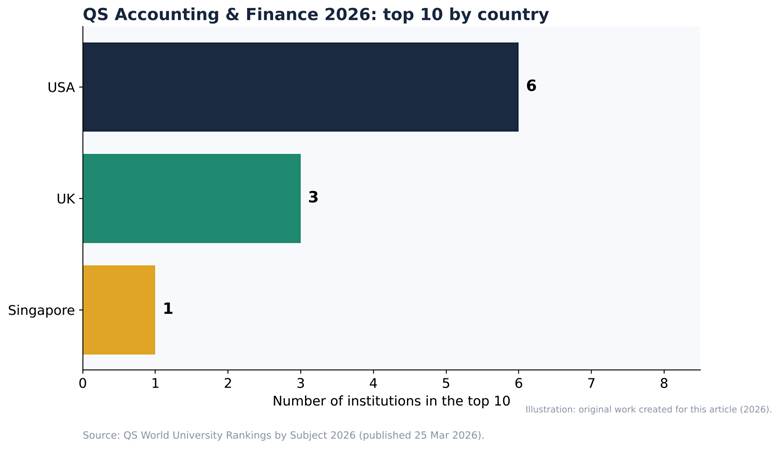
Figure: Bar chart showing the number of top-10 QS Accounting and Finance 2026 universities by country. Original illustration created for this article.
Top Universities Offering Stock Market and Finance Programs in 2026
Short answer: According to the QS World University Rankings by Subject 2026 for Accounting & Finance, published on 25 March 2026, Harvard University ranks first, with four of the top five places held by US institutions and the University of Oxford in fourth. Other leading names include Stanford, MIT, the University of Chicago, the University of Pennsylvania (Wharton), Cambridge and the London School of Economics. For students focused specifically on securities markets in India, the National Institute of Securities Markets (NISM), established by SEBI, offers specialised full-time programmes.
Rankings are a starting point, not a decision. The right university depends on whether you want a theoretical economics foundation, quantitative finance skills or a practical route into trading, research or investment management.
The 2026 Global Leaders in Finance
The table below lists institutions that appear at the top of the QS Accounting & Finance 2026 subject ranking.
| Rank (QS 2026) | University | Country |
| 1 | Harvard University | USA |
| 2 | Stanford University | USA |
| 3 | Massachusetts Institute of Technology (MIT) | USA |
| 4 | University of Oxford | UK |
| 5 | University of Chicago | USA |
| 6 | University of Pennsylvania | USA |
| 7 | University of Cambridge | UK |
| 8 | London School of Economics and Political Science | UK |
| 9 | University of California, Berkeley | USA |
| 10 | National University of Singapore | Singapore |
Rank positions should be confirmed on the official QS website, as tables can be updated.
Notable Programmes and What Makes Them Different
MIT Sloan – Master of Finance
MIT Sloan's MFin is offered as a standard 18-month curriculum or an accelerated 12-month option. Students can choose concentrations in Capital Markets, Corporate Finance, Financial Engineering, Climate and Social Impact Finance, and FinTech. The programme includes Action Learning projects with industry partners and carries a STEM designation, which matters to international students in the US.
Good fit for: quantitatively strong graduates targeting trading, asset management or fintech.
Princeton University – Master in Finance
Princeton's Bendheim Center for Finance runs a two-year Master in Finance that draws on economics, operations research and financial engineering, computer science and mathematics. Students who complete the programme in two years can also earn a graduate certificate in statistics and machine learning.
Good fit for: students aiming for quantitative research and data-driven investment roles.
University of Pennsylvania – The Wharton School
Wharton's finance department supports students at undergraduate, MBA and PhD levels. Its finance concentration is among the best known in the world, with strong recruiting links to investment banks and asset managers.
Good fit for: undergraduates and MBA candidates seeking broad finance careers with strong employer networks.
London School of Economics
LSE ranks eighth in the QS subject table and is known for rigorous economics-based finance teaching in the heart of a global financial centre.
Good fit for: students who want proximity to London's markets and an economics-heavy curriculum.
National Institute of Securities Markets (India)
NISM is SEBI's education initiative and runs full-time programmes at its 70-acre campus in Patalganga, Maharashtra, including the Post Graduate Diploma in Management (Securities Markets), an LLM in Investment and Securities Laws, and postgraduate programmes in investment and securities markets. NISM also administers the certification examinations that SEBI requires for many associated persons working at market intermediaries.
Good fit for: Indian students targeting careers with brokers, exchanges, asset managers and regulators.
Comparing Programme Types
| Programme type | Typical length | Focus | Typical career outcome |
| Undergraduate finance degree | 3–4 years | Foundations of finance, accounting, economics | Analyst roles, further study |
| Master in Finance (pre-experience) | 1–2 years | Advanced theory, quantitative methods | Trading, research, asset management |
| MBA with finance major | 1–2 years | Management with finance specialisation | Investment banking, corporate finance, leadership |
| Specialised securities programmes (e.g., NISM) | 1–2 years | Market operations, regulation, products | Broking, exchanges, compliance, fund houses |
| PhD in finance | 4–6 years | Academic research | Academia, quant research |
Practical Example: Choosing Between Two Offers
Ravi holds offers from a one-year Master in Finance in the UK and a two-year specialised securities markets programme in India. He wants to work in equity research in Mumbai. The UK degree carries global brand recognition, but the Indian programme offers direct exposure to SEBI regulations, NISM certifications and local recruiters. Ravi weighs total cost, the recruiting network in his target city and the curriculum's relevance. For a Mumbai-based career with a limited budget, the specialised Indian programme may provide a better return; for an international career, the global degree may be worth the higher cost.
Pros and Cons of a University Finance Programme
Pros
- Structured, rigorous curriculum taught by research faculty
- Recognised credential valued by employers
- Recruiting networks and alumni access
- Access to data, labs and trading simulators
Cons
- High tuition and living costs at top institutions
- Competitive admissions
- Theory-heavy content may not teach day-to-day trading
- A degree alone does not guarantee investment returns or employment
How to Choose the Right University
1. Clarify your goal: research, trading, corporate finance or regulation.
2. Check curriculum depth: look for courses in portfolio management, derivatives, financial econometrics and data science.
3. Review employment reports published by the school.
4. Consider location: proximity to financial centres helps internships.
5. Compare total cost against realistic salary outcomes.
6. Look at professional alignment: some programmes map content to designations such as CFA.
Key Takeaways
- Harvard ranks first in the QS 2026 Accounting & Finance subject ranking, with Oxford fourth.
- MIT offers a 12- or 18-month MFin; Princeton runs a two-year Master in Finance.
- Wharton supports finance study from undergraduate to PhD level.
- NISM is India's specialised option for securities market careers.
- Match the programme to your career goal, budget and preferred location.
Frequently Asked Questions
Which university is best for finance in 2026?
In the QS World University Rankings by Subject 2026 for Accounting & Finance, Harvard University ranks first. Stanford, MIT, Oxford and the University of Chicago are also among the leaders.
Do I need a finance degree to work in the stock market?
No, but it helps. Many roles in India require NISM certifications, and globally many analysts combine a relevant degree with professional designations such as CFA.
How long is MIT's Master of Finance?
MIT Sloan offers an 18-month standard programme and an accelerated 12-month option.
What is NISM?
The National Institute of Securities Markets is an educational initiative of SEBI. It runs full-time programmes in securities markets and conducts the certification exams required for many market intermediary staff in India.
Is a Master in Finance better than an MBA for trading?
For early-career, quantitatively focused candidates, a Master in Finance is often more directly relevant. An MBA suits professionals with work experience who want broader management roles.
Financial Disclaimer
This article is for general information and education only and does not constitute investment, financial, legal or tax advice, or a recommendation to buy or sell any security. Investing in securities involves risk, including possible loss of principal. Fees, features, rankings and regulations cited were checked against the listed sources on 15 October 2026 and may change without notice. Verify current details with the provider or regulator and consider consulting a SEBI-registered investment adviser, a FINRA-registered professional or another qualified adviser before making financial decisions.
Source References
1. QS World University Rankings by Subject 2026: Accounting & Finance — https://www.topuniversities.com/university-subject-rankings/accounting-finance
2. MIT Sloan – Master of Finance — https://mitsloan.mit.edu/mfin
3. Princeton Bendheim Center – Master in Finance — https://bcf.princeton.edu/master-in-finance/
4. Wharton Finance Department — https://finance.wharton.upenn.edu/
5. NISM – Programmes and news — https://www.nism.ac.in/news/the-reform-dialogues-nism-director-sashi-krishnan-on-bringing-real-world-financial-markets-into-the-mba-classroom
6. NSE – NISM certification and CPE — https://www.nseindia.com/learn/nism-continuing-professional-education-cpe-program
All sources were accessed on 15 October 2026.
Suggested Internal Links
| Anchor text | Suggested URL |
| Best Online Stock Market Courses: Certified and Accredited Options | /best-online-stock-market-courses-certified |
| Stock Market Education for Beginners | /stock-market-education-beginners-guide |
| Fundamental vs Technical Analysis Tools | /fundamental-vs-technical-analysis-tools |