Advanced Trading Platforms for Professional Investors: A 2026 Comparison
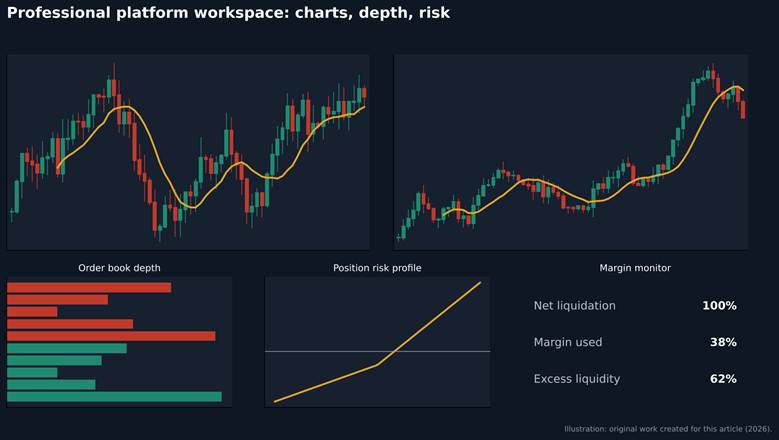
Figure: Dark-theme professional trading workspace with candlestick charts, order book depth, risk profile and margin monitor. Original illustration created for this article.
Advanced Trading Platforms for Professional Investors: A 2026 Comparison
Short answer: For professional investors who need global market access, advanced order types and institutional-style risk tools, Interactive Brokers' Trader Workstation (TWS) is the most comprehensive retail-accessible platform. Schwab's thinkorswim is the strongest choice for US options and futures analysis, Fidelity Trader+ suits Fidelity clients who want a modern multi-monitor workspace, and Zerodha's Kite ecosystem is the leading choice for Indian markets. The best platform depends on your asset classes, the markets you trade and how much you rely on automation.
This article compares platforms. If you want to know how to build a complete professional workflow around a platform, including execution, risk and automation, see our companion guide on professional trading workflows.
What Separates an Advanced Platform From a Basic App
Professional investors judge platforms on criteria that rarely matter to beginners:
- Order types and algorithms: VWAP, TWAP, iceberg, bracket, conditional and multi-leg orders.
- Market access: the number of exchanges, countries and asset classes available from one account.
- Real-time risk: live margin, P&L, exposure and scenario analysis across the whole portfolio.
- Data quality: depth of book, time-and-sales, options analytics and historical data.
- Customisation: linked windows, hotkeys, saved layouts and scripting.
- Programmatic access: APIs for automated or semi-automated trading.
- Execution cost: per-share pricing, exchange rebates and fee transparency.
Platform Comparison
| Feature | IBKR Trader Workstation | Schwab thinkorswim | Fidelity Trader+ | Zerodha Kite |
| Primary strength | Global multi-asset access | Options and futures analytics | Integrated Fidelity workspace | Indian equities and F&O |
| Versions | Desktop, web, mobile | Desktop, web, mobile | Desktop (Windows/macOS), web, mobile | Web, mobile |
| Order types | 100+ (Classic TWS) incl. VWAP/TWAP algos | Advanced conditional and multi-leg | Advanced orders and multi-leg options | Standard, bracket/cover and GTT orders |
| Market reach | 100+ markets worldwide (per IBKR) | US-focused; stocks, ETFs, options, futures, forex | US-focused | NSE, BSE, MCX |
| Risk tools | Real-time margin, stress tests, scenario analysis | Analyze tab, risk profiles, paperMoney | Position and account monitoring | Margin and position views |
| Programmatic access | Yes (IBKR APIs) | Limited retail API | Not a core feature | Kite Connect API |
| Stock pricing | Pro: from $0.0035/share tiered or $0.005 fixed | $0 online US-listed | $0 online US | ₹0 delivery; ₹20 cap intraday |
Pricing reflects official broker pages on 15 October 2026.
Interactive Brokers Trader Workstation
TWS is built for traders who need breadth. IBKR says the platform provides access to more than 100 markets, and its Classic interface offers over 100 order types, including algorithmic orders such as VWAP, TWAP and percentage-of-volume. Real-time margin monitoring, portfolio risk analysis and scenario stress tests are built in.
IBKR Pro pricing is designed for active traders: tiered pricing starts at $0.0035 per share and falls with monthly volume, while fixed pricing is $0.005 per share with a $1 minimum per order. For large orders, the transparency and routing control often matter more than a $0 headline.
Best for: global macro investors, multi-currency portfolios, options and futures traders needing one account across regions.
Schwab thinkorswim
thinkorswim is known for its analytical depth. It provides hundreds of technical studies and drawing tools, a strong options chain and the paperMoney simulator for testing ideas with live data. It covers stocks, ETFs, options, futures and forex, and Schwab offers 24/5 trading in more than 1,300 stocks and ETFs.
Best for: US-focused options and futures traders who value charting and strategy analysis.
Fidelity Trader+
Fidelity Trader+ is Fidelity's most advanced platform and is replacing Active Trader Pro, which Fidelity plans to begin retiring in 2027. The desktop version runs on 64-bit Windows and macOS with a widget-based layout across multiple monitors, and it connects with web and mobile versions.
Best for: existing Fidelity clients consolidating long-term and active portfolios in one place.
Zerodha Kite
For professionals trading Indian markets, Kite offers a fast web and mobile interface, Good Till Triggered (GTT) orders and access to NSE, BSE and MCX. The Kite Connect API lets developers build their own tools. Since SEBI's retail algorithmic trading framework became fully applicable on 1 April 2026, API-based strategies must run through broker-registered systems.
Best for: active traders and developers focused on Indian equities and derivatives.
Practical Example: Matching a Platform to a Mandate
A portfolio manager running a global equity-plus-hedging strategy needs to buy European stocks, hedge currency exposure and trade US index options from one account. TWS fits because of its multi-market reach and portfolio-level margin view.
A US options specialist who sells premium on index ETFs every week will spend most time in analytics: probability cones, Greeks and position risk graphs. thinkorswim is the more natural fit.
An Indian proprietary trader running intraday strategies in index futures needs speed, low costs and a compliant API. Kite with Kite Connect suits that profile.
Pros and Cons of Advanced Platforms
Pros
- Precise execution control and sophisticated order types
- Portfolio-level risk visibility
- Customisable layouts for multi-monitor setups
- API access for automation
Cons
- Steep learning curves; misconfigured orders can be costly
- Market data subscriptions often cost extra
- Per-share pricing can exceed $0 apps for small accounts
- More features mean more ways to make errors
Key Takeaways
- IBKR TWS leads on global access, order types and risk tools.
- thinkorswim leads on US options and futures analytics.
- Fidelity Trader+ is the modern successor to Active Trader Pro.
- Zerodha Kite is the leading professional-grade choice for Indian markets, with API access under SEBI's algo framework.
- Choose by asset class, market reach and automation needs, not by headline price.
Frequently Asked Questions
What is the best trading platform for professional investors?
It depends on the mandate. Interactive Brokers TWS is the most comprehensive for global multi-asset trading, while thinkorswim is stronger for US options analytics and Zerodha Kite for Indian markets.
Do professional platforms charge commissions?
Some do. IBKR Pro charges per share, starting at $0.0035 on tiered pricing, while Schwab and Fidelity offer $0 online US stock trades. Professionals often accept per-share pricing in exchange for routing control.
Is thinkorswim suitable for professionals?
Yes, especially for US options and futures traders. It offers extensive charting, options analytics and a paper-trading simulator, though its global market access is narrower than IBKR's.
Can I use APIs for algorithmic trading in India?
Yes, through broker APIs such as Kite Connect, but since April 2026 retail algorithmic trading must comply with SEBI's framework, which requires strategies to be registered through brokers with the exchanges.
Is Fidelity Active Trader Pro being discontinued?
Fidelity says it will begin sunsetting Active Trader Pro in 2027 and encourages users to move to Fidelity Trader+.
Financial Disclaimer
This article is for general information and education only and does not constitute investment, financial, legal or tax advice, or a recommendation to buy or sell any security. Investing in securities involves risk, including possible loss of principal. Fees, features, rankings and regulations cited were checked against the listed sources on 15 October 2026 and may change without notice. Verify current details with the provider or regulator and consider consulting a SEBI-registered investment adviser, a FINRA-registered professional or another qualified adviser before making financial decisions.
Source References
1. Interactive Brokers – Trader Workstation — https://www.interactivebrokers.com/en/trading/tws.php
2. Interactive Brokers – Stock commissions — https://www.interactivebrokers.com/en/pricing/commissions-stocks.php
3. Charles Schwab – thinkorswim — https://www.schwab.com/trading/thinkorswim
4. Fidelity – Active Trader Pro to Fidelity Trader+ transition — https://www.fidelity.com/investing/trading-platforms/active-trader-pro-transition
5. Zerodha – Charges — https://zerodha.com/charges/
6. Outlook Business – SEBI retail algo framework timeline — https://www.outlookbusiness.com/markets/sebi-extends-deadline-to-implement-retail-algo-trading-by-april-2026
All sources were accessed on 15 October 2026.
Suggested Internal Links
| Anchor text | Suggested URL |
| Professional Trading Workflows (companion guide) | /professional-trading-workflow-execution-risk-automation |
| Fundamental vs Technical Analysis Tools | /fundamental-vs-technical-analysis-tools |
| Mobile vs Desktop Trading Platforms | /mobile-vs-desktop-trading-platforms |