Best Online Stock Trading Platforms for Beginners in 2026
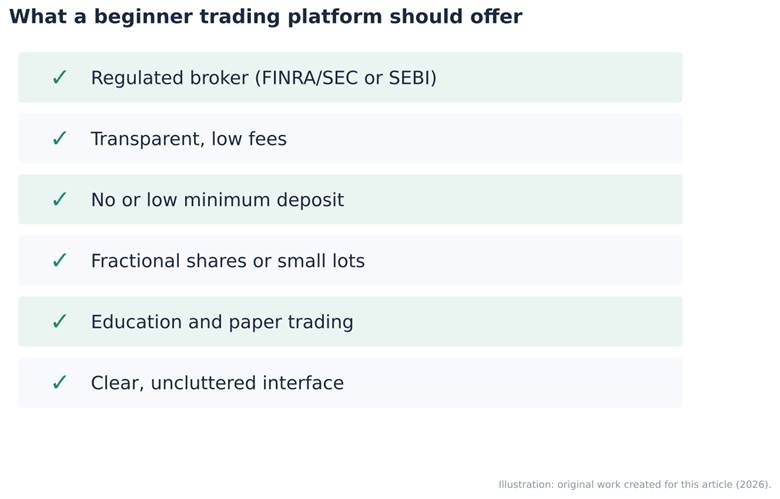
Figure: Checklist of six features a beginner online trading platform should offer. Original illustration created for this article.
Best Online Stock Trading Platforms for Beginners in 2026
Short answer: For most US beginners, Fidelity and Charles Schwab offer the best balance of $0 stock commissions, no account minimums, strong education and reliable customer service. Robinhood is the easiest app to learn but offers fewer research tools. In India, Zerodha and Groww are popular first choices, with Zerodha charging ₹0 brokerage on equity delivery and Groww charging no annual demat maintenance fee. The right choice depends on whether you value learning resources, simplicity or low costs most.
A good beginner platform is not the one with the most features. It is the one that helps you avoid costly mistakes while you learn.
What Beginners Should Look For
1. Regulation and protection. The broker should be registered with FINRA and the SEC in the US, or with SEBI in India.
2. Low, transparent costs. $0 commissions are now standard in the US; check options, transfer and maintenance fees.
3. No or low minimum deposit. This lets you start small.
4. Fractional shares. Buying a slice of an expensive stock helps you diversify with modest sums.
5. Education and practice tools. Articles, videos, webinars and paper trading accounts shorten the learning curve.
6. Clear interface. A cluttered screen increases the chance of placing the wrong order.
Beginner Platform Comparison (October 2026)
| Platform | Market | Stock/ETF brokerage | Minimum | Beginner strengths | Limitations |
| Fidelity | US | $0 online | None | Extensive learning centre, fractional shares, phone support | Advanced platform has a learning curve |
| Charles Schwab | US | $0 (US-listed) | None | thinkorswim paperMoney simulator, education, branches | Many tools can overwhelm new users |
| Robinhood | US | $0 | None | Very simple app, fractional shares | Fewer research tools; premium features cost $5/month |
| Zerodha | India | ₹0 delivery | None | Free Varsity learning modules, Kite platform | AMC applies after year one |
| Groww | India | ₹20 or 0.1% (lower), min ₹5 | None | Simple app, ₹0 AMC | Fewer advanced analysis tools |
Fees are taken from each broker's official pricing page and may change.
Platform Notes
Fidelity
Fidelity combines $0 online stock and ETF trades with no account minimum and a large educational library. Options trades carry a $0.65 per-contract fee. Beginners who later become more active can move to Fidelity Trader+, the firm's newer advanced platform, without switching brokers.
Charles Schwab
Schwab's main attraction for learners is thinkorswim's paperMoney feature, a simulated trading environment that uses live market data with virtual funds. Practising there for a few weeks is one of the cheapest ways to learn how orders, stop-losses and options actually behave.
Robinhood
Robinhood's design removes friction, which is helpful at the start but can also make trading feel too easy. If you choose it, set personal rules about how often you trade.
Zerodha and Groww (India)
Zerodha's Varsity modules cover markets from basics to derivatives at no cost, and its Kite platform is widely used. Groww appeals to beginners who want stocks and mutual funds in one simple app with no annual maintenance charge. Both require a demat account and KYC.
A Big 2026 Change for US Beginners: The PDT Rule
For years, US margin accounts with less than $25,000 in equity were restricted once they were classified as "pattern day traders." In 2026 the SEC approved FINRA rule changes that eliminated the pattern day trader designation and its $25,000 minimum, replacing it with a real-time intraday margin framework. E*TRADE, for example, says it implemented the changes on 9 June 2026. The standard $2,000 minimum for margin accounts still applies.
For beginners, this removes an artificial limit but not the risk. Frequent day trading with borrowed money is still one of the fastest ways for new investors to lose capital. A cash account remains the sensible starting point.
Practical Example: Starting With $500 or ₹25,000
US investor with $500: Open a cash account at Fidelity or Schwab. Buy fractional shares of a broad index ETF, set up a monthly automatic investment, and use the broker's education section to learn about diversification. Total commission paid: $0.
Indian investor with ₹25,000: Open a demat and trading account with Zerodha or Groww after completing KYC. Buy units of a diversified index fund or ETF for delivery. At Zerodha the brokerage on that delivery purchase is ₹0; statutory charges such as stamp duty still apply.
In both cases the most important decision is what you buy and how long you hold it, not the platform.
Pros and Cons of Starting With an Online Platform
Pros
- Very low or zero commissions
- Small minimums and fractional shares
- Free education and simulators
- Full control over your investments
Cons
- No personalised advice unless you pay for it
- Easy access can encourage impulsive trades
- Feature-heavy platforms can confuse beginners
- Margin and options can be enabled before you understand them
Common Beginner Mistakes to Avoid
- Trading on tips from social media or messaging groups. In India, check that any adviser or research analyst is SEBI-registered.
- Ignoring diversification by putting everything in one or two stocks.
- Using margin or options before understanding the downside.
- Checking prices constantly and reacting emotionally.
Key Takeaways
- Fidelity and Schwab are strong all-round US choices for beginners; Robinhood is simplest but lighter on research.
- Zerodha and Groww are the leading beginner-friendly options in India, with different fee models.
- Use paper trading before risking real money.
- The US pattern day trader $25,000 minimum was eliminated in 2026, but day trading remains high risk.
- Choose a regulated broker with clear fees and good education.
Frequently Asked Questions
Which trading platform is best for a complete beginner?
In the US, Fidelity and Charles Schwab are strong choices because of $0 stock commissions, no minimums and extensive education. In India, Zerodha and Groww are widely used by first-time investors.
How much money do I need to start trading stocks?
Many brokers have no account minimum, and fractional shares let US investors start with a few dollars. In India you can begin with the price of a single share or a small mutual fund investment.
Is the $25,000 pattern day trader rule still in effect?
No. In 2026 the SEC approved FINRA changes that removed the pattern day trader designation and its $25,000 equity requirement, replacing it with intraday margin rules. The $2,000 margin account minimum remains.
Should beginners use paper trading?
Yes. Simulators such as thinkorswim's paperMoney let you practise placing orders with virtual money using live market data, which helps you learn without financial risk.
Are free trading apps safe for beginners?
Apps from regulated brokers are generally safe in terms of custody, but check FINRA/SIPC membership in the US or SEBI registration in India, and enable two-factor authentication.
Financial Disclaimer
This article is for general information and education only and does not constitute investment, financial, legal or tax advice, or a recommendation to buy or sell any security. Investing in securities involves risk, including possible loss of principal. Fees, features, rankings and regulations cited were checked against the listed sources on 15 October 2026 and may change without notice. Verify current details with the provider or regulator and consider consulting a SEBI-registered investment adviser, a FINRA-registered professional or another qualified adviser before making financial decisions.
Source References
1. Fidelity – Commissions and margin rates — https://www.fidelity.com/trading/commissions-margin-rates
2. Charles Schwab – Pricing — https://www.schwab.com/pricing
3. Charles Schwab – thinkorswim — https://www.schwab.com/trading/thinkorswim
4. Robinhood – Robinhood Gold — https://robinhood.com/us/en/gold/
5. Zerodha – Charges — https://zerodha.com/charges/
6. Groww – Pricing — https://groww.in/pricing
7. E*TRADE – Pattern day trading rule change — https://us.etrade.com/knowledge/library/margin/pattern-day-trading-rule-change
8. FINRA BrokerCheck — https://brokercheck.finra.org/
All sources were accessed on 15 October 2026.
Suggested Internal Links
| Anchor text | Suggested URL |
| Stock Market Education for Beginners: Step-by-Step Guide | /stock-market-education-beginners-guide |
| Top Commission-Free Trading Apps Compared | /commission-free-trading-apps-compared |
| Best Online Stock Market Courses | /best-online-stock-market-courses-certified |