Commission-Free Trading Apps Compared: What "Free" Really Costs in 2026
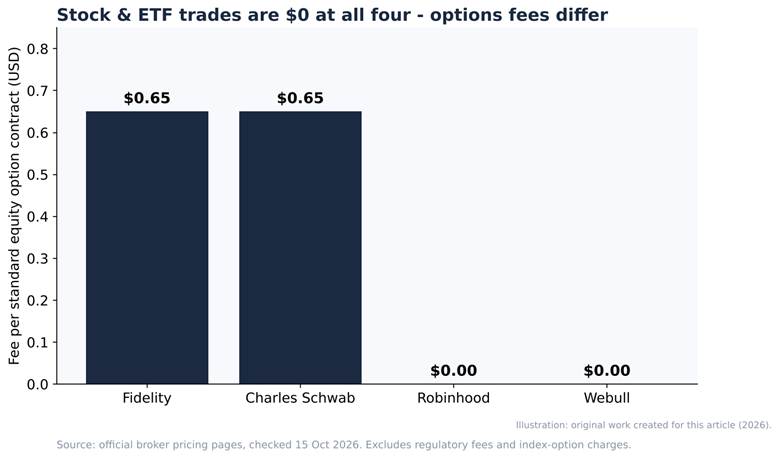
Figure: Bar chart comparing per-contract options fees at Fidelity, Charles Schwab, Robinhood and Webull, October 2026. Original illustration created for this article.
Commission-Free Trading Apps Compared: What "Free" Really Costs in 2026
Short answer: In the US, Fidelity, Charles Schwab, Robinhood, Webull and IBKR Lite all charge $0 commission on online trades in US-listed stocks and ETFs. The real differences show up elsewhere: options contract fees, account transfer charges, how your orders are routed, and what you pay for premium features. In India, Zerodha charges nothing for equity delivery trades, while Groww applies a small capped brokerage on equity orders. "Commission-free" describes one fee line, not the total cost of investing.
This comparison uses each broker's own published pricing pages, checked on 15 October 2026. Fees change often, so treat the figures below as a snapshot and confirm them before you open an account.
How Commission-Free Brokers Make Money
A broker that waives commissions still has to cover technology, compliance and customer support. The main revenue sources are:
- Payment for order flow (PFOF): some brokers route retail orders to market makers who pay for that order flow. The US SEC has long required brokers to disclose these arrangements, and critics argue they can affect execution quality.
- Interest on cash balances: brokers earn a spread on uninvested cash and margin loans.
- Per-contract fees: options are usually "commission-free" at the order level but carry a fee for each contract.
- Subscriptions: premium tiers sell faster deposits, higher cash yields or research.
- Account service charges: outgoing transfers, paper statements and broker-assisted trades.
Understanding which of these applies to you matters more than the headline $0.
US Commission-Free Apps: Side-by-Side
| Broker | US stocks & ETFs (online) | Options | Account minimum | Notable extra costs |
| Fidelity | $0 | $0.65 per contract | None | Regulatory fees on sells |
| Charles Schwab | $0 (US exchange-listed) | $0.65 per contract | None | $25 broker-assisted trade charge |
| Robinhood | $0 | $0 commission; index options carry fees | None | Robinhood Gold is $5 per month |
| Webull | $0 (US-listed) | $0 on most; $0.50 per contract on certain index options | None | $75 per outgoing stock transfer |
| IBKR Lite | $0 on US exchange-listed stocks & ETFs | Per-contract pricing | None | US residents only; some order types billed at fixed rates |
Sources: official pricing pages of each broker (listed in the references).
Fidelity
Fidelity suits long-term investors who want a full-service firm without account minimums. Online US stock, ETF and option trades carry no commission, but options cost $0.65 per contract. Fidelity also offers fractional shares and a large research library. Its active-trader platform is moving from Active Trader Pro to Fidelity Trader+, with the older software scheduled to begin retiring in 2027.
Charles Schwab
Schwab matches Fidelity on stock and options pricing and adds thinkorswim, a desktop, web and mobile platform that came over from TD Ameritrade. If you place a trade through a representative, Schwab adds a $25 service charge, so self-directed investors benefit most.
Robinhood
Robinhood remains the simplest mobile experience. Basic trading is free, and the optional Gold subscription costs $5 per month. At the time of writing, Robinhood advertises 3.6% APY on eligible brokerage cash for Gold members, along with an IRA contribution match. Rates on cash are variable and can change at any time.
Webull
Webull targets active traders with detailed charts, extended-hours trading and a desktop app. It charges no commission on US-listed stocks, ETFs and most options, but its fee page lists a $0.50 per-contract charge on certain index options and $75 for each outgoing stock transfer. That transfer fee is worth noting if you think you may switch brokers later.
IBKR Lite
Interactive Brokers' Lite plan offers commission-free US-listed stocks and ETFs to US residents, with access to a very wide range of global markets. However, some orders, such as non-listed stocks and certain outside-hours trades above a monthly threshold, fall back to fixed pricing. Active traders often choose IBKR Pro instead, which charges per share but is designed around execution quality.
India: Zerodha vs Groww
| Charge | Zerodha | Groww |
| Equity delivery brokerage | ₹0 for retail individuals | ₹20 or 0.1% of order value, whichever is lower (minimum ₹5) |
| Intraday equity | 0.03% or ₹20 per order, whichever is lower | ₹20 or 0.1%, whichever is lower |
| Account opening | Free for individuals | Free |
| Demat AMC | Free in year one; slab-based afterwards | ₹0 |
Indian investors also pay statutory charges that no broker can waive, including Securities Transaction Tax (STT), exchange transaction charges, SEBI fees, stamp duty and 18% GST on certain charges. Depository participant (DP) charges also apply when you sell shares from your demat account.
A Practical Cost Example
Suppose a US investor buys 10 call option contracts and later sells them.
- At Fidelity or Schwab: 20 contracts × $0.65 = $13.00, plus small regulatory fees.
- At Robinhood or Webull (standard equity options): $0 in commission, plus regulatory fees.
Now consider a long-term investor in India who buys ₹50,000 of shares and holds them. At Zerodha, brokerage is ₹0. At Groww, brokerage would be capped at ₹20 for that order. In both cases STT, stamp duty and later DP charges still apply. For a buy-and-hold investor making a handful of trades a year, these differences are small; for someone placing dozens of orders a month, they add up.
Pros and Cons of Commission-Free Trading Apps
Pros
- Low barrier to entry, with no minimum deposits at the brokers covered here
- Fractional shares make diversified portfolios affordable with small sums
- Transparent pricing for basic stock and ETF trades
Cons
- Free trading can encourage overtrading
- Options, transfer and subscription fees can exceed what a commission would have cost
- Order-routing arrangements may affect the price you receive
- Customer support depth varies widely
How to Choose
1. Match the app to your activity. Long-term ETF investors should prioritise account protections, research and low cash drag. Options traders should compare per-contract fees first.
2. Read the full fee schedule, not the marketing page.
3. Check regulation. In the US, confirm the broker is a FINRA member using BrokerCheck. In India, confirm SEBI registration.
4. Consider exit costs. Outgoing transfer fees matter if you might switch.
5. Test the platform. Many brokers offer paper trading or demo accounts.
Key Takeaways
- All major US apps covered here charge $0 for online US stock and ETF trades.
- Options fees range from $0 to $0.65 per contract, which is the biggest cost gap.
- Zerodha keeps equity delivery free in India; Groww charges a small capped fee but no AMC.
- Statutory and regulatory charges apply everywhere, regardless of the broker.
- Choose based on how you trade, not on the "$0" headline.
Frequently Asked Questions
Are commission-free trading apps really free?
Not entirely. They remove the commission on basic stock and ETF trades, but you may still pay options contract fees, regulatory fees, transfer fees, subscription costs or wider spreads tied to order routing.
Which commission-free app is cheapest for options trading?
Among the US apps reviewed, Robinhood and Webull charge no commission on standard equity options, while Fidelity and Schwab charge $0.65 per contract. Index options can carry separate fees at several brokers.
Is Zerodha completely free for delivery trades?
Zerodha charges ₹0 brokerage on equity delivery for retail individuals, but statutory charges such as STT, stamp duty, exchange fees, GST and DP charges on selling still apply.
How do I know if a trading app is safe?
Check that the broker is registered with the relevant regulator, such as FINRA and the SEC in the US or SEBI in India. In the US, also confirm SIPC membership, which protects customer securities if a member firm fails, within limits.
Do commission-free brokers sell my orders?
Some receive payment for order flow from market makers. Brokers must disclose this in their order-routing reports. If execution quality matters to you, read those disclosures before choosing.
Financial Disclaimer
This article is for general information and education only and does not constitute investment, financial, legal or tax advice, or a recommendation to buy or sell any security. Investing in securities involves risk, including possible loss of principal. Fees, features, rankings and regulations cited were checked against the listed sources on 15 October 2026 and may change without notice. Verify current details with the provider or regulator and consider consulting a SEBI-registered investment adviser, a FINRA-registered professional or another qualified adviser before making financial decisions.
Source References
1. Fidelity – Commissions and margin rates — https://www.fidelity.com/trading/commissions-margin-rates
2. Charles Schwab – Pricing — https://www.schwab.com/pricing
3. Robinhood – Robinhood Gold — https://robinhood.com/us/en/gold/
4. Webull – Pricing — https://www.webull.com/pricing
5. Interactive Brokers – Stock commissions — https://www.interactivebrokers.com/en/pricing/commissions-stocks.php
6. Zerodha – Charges — https://zerodha.com/charges/
7. Groww – Pricing — https://groww.in/pricing
8. SEC – Final rule on payment for order flow disclosure — https://www.sec.gov/rules-regulations/1994/10/payment-order-flow
9. FINRA BrokerCheck — https://brokercheck.finra.org/
All sources were accessed on 15 October 2026.
Suggested Internal Links
| Anchor text | Suggested URL |
| Best Online Stock Trading Platforms for Beginners in 2026 | /best-online-stock-trading-platforms-beginners-2026 |
| Mobile vs Desktop Trading Platforms | /mobile-vs-desktop-trading-platforms |
| Paid vs Free Stock Research Services | /paid-vs-free-stock-research-services |