Paid vs Free Stock Research Services: Which Delivers Better Value?
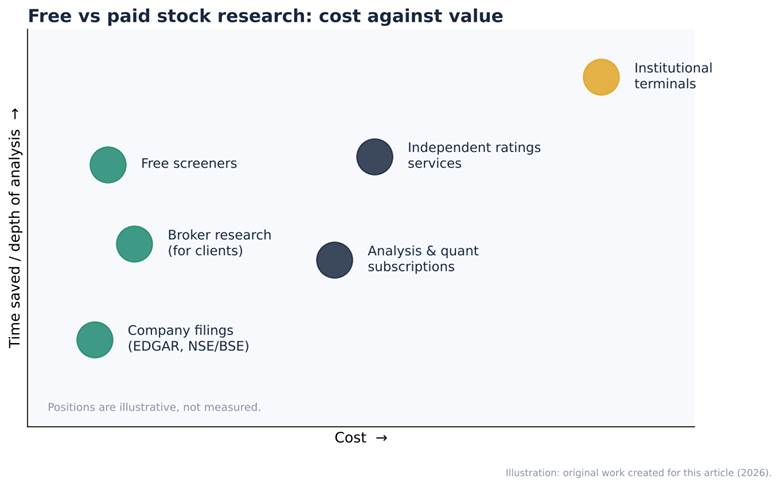
Figure: Positioning chart of free and paid stock research sources by cost and depth of analysis. Original illustration created for this article.
Paid vs Free Stock Research Services: Which Delivers Better Value?
Short answer: Free sources now cover most of what individual investors need: original company filings on SEC EDGAR or Indian exchange websites, third-party research bundled with many brokerage accounts, free screeners and regulator education. Paid services earn their cost when they save significant time, provide independent ratings you would not produce yourself, or offer deeper historical data. A paid subscription is worth it only if you will use it regularly and it changes your decisions. In India, any paid stock recommendation service should be provided by a SEBI-registered research analyst or investment adviser.
What Free Research Gives You
| Free source | What you get | Limitation |
| SEC EDGAR | Free access to US company filings, insider forms, fund documents | Raw data; requires interpretation |
| NSE / BSE disclosures | Annual reports, results and announcements for Indian companies | No analysis or ratings |
| Broker research | Third-party and in-house reports for account holders at many brokers | Coverage and depth vary by broker |
| Free screeners | Filter stocks by valuation, growth and quality metrics | Limited history and custom formulas |
| Financial news portals | Prices, headlines and summaries | Often shallow; may be ad-driven |
| Regulator education (Investor.gov, SEBI) | Unbiased explanations of products and risks | Not stock-specific |
Primary filings are arguably the most valuable free resource because every paid service ultimately relies on them.
What Paid Research Adds
| Paid service type | Examples | What you pay for |
| Independent ratings and fair values | Morningstar Investor | Analyst fair-value estimates, moat and uncertainty ratings, portfolio tools |
| Crowd-sourced analysis plus quant ratings | Seeking Alpha Premium | Contributor articles, quant factor grades, earnings call transcripts |
| Professional data terminals | Bloomberg and similar institutional systems | Real-time multi-asset data, analytics and messaging; priced for institutions |
| Recommendation services (India) | SEBI-registered research analysts | Specific stock recommendations with regulated disclosures |
Pricing varies and promotions are common. Seeking Alpha Premium's list price has been around USD 299 per year according to independent reviews, but always confirm the current price on the provider's own checkout page.
Free vs Paid: Head-to-Head
| Factor | Free research | Paid research |
| Cost | ₹0 / $0 | Monthly or annual subscription |
| Data depth | Basic to moderate | Moderate to deep, with long histories |
| Independent opinions | Limited | Core feature |
| Time saved | Low; you do the work | High; summaries and ratings |
| Bias risk | Ad-driven sites may sensationalise | Possible conflicts; check disclosures |
| Best for | Beginners, DIY analysts, long-term investors | Active investors, time-constrained professionals |
When Free Research Is Enough
- You invest mainly in index funds or ETFs.
- You hold a small number of stocks you understand well.
- You enjoy reading annual reports and building your own spreadsheets.
- Your broker already provides third-party research reports.
When Paying Makes Sense
- You manage a larger portfolio, where a better decision on one position can outweigh the subscription.
- You need independent valuation views to challenge your own assumptions.
- You lack time to read filings in full.
- You want consistent screening data across many years and markets.
A simple rule: estimate the hours a service saves you each month and the decisions it will genuinely improve. If you cannot name either, the subscription is probably not worth it.
Red Flags in Paid Research
- Guaranteed or "assured" returns
- Pressure to subscribe immediately or pay through personal accounts
- Tips through social media or messaging groups without registration details
- No disclosure of the analyst's holdings or conflicts
In India, SEBI has repeatedly urged investors to verify registration before acting on investment tips. A registered research analyst must provide a valid SEBI registration number, which you can check on SEBI's website. Contact from generic mobile numbers instead of the official registered-entity series can be a warning sign.
Questions to Ask Before You Subscribe
1. Who produces the research? Look for named analysts with stated methods, not anonymous "experts".
2. Is there a track record? Credible services explain how ratings performed over time, including misses.
3. What markets are covered? A service built for US stocks may add little for an investor focused on Indian mid-caps.
4. Is there a trial or refund policy? Use a trial period to test whether you actually read the output.
5. How are conflicts handled? Check whether analysts can own the stocks they cover and how this is disclosed.
6. Can you export data? Exportable screens and histories make the subscription more useful for your own models.
Writing down your answers before paying makes it easier to cancel services that do not earn their place.
Practical Example: Building a Hybrid Research Stack
Sunita manages a ₹30 lakh equity portfolio of about 15 stocks.
1. Free layer: she reads quarterly results and annual reports on exchange websites and uses a free screener to monitor valuations.
2. Broker layer: she reviews research reports provided through her brokerage account.
3. Paid layer: she subscribes to one independent research service to get a second opinion on valuation before adding new positions.
4. Review: each year she checks how often the paid service changed her decision. If it rarely does, she cancels.
The result is a cost-effective process that uses paid research only where it adds value.
Pros and Cons
Free stock research
- Pros: no cost; access to primary documents; unbiased regulator education
- Cons: time-intensive; limited analysis; quality varies across websites
Paid stock research
- Pros: saves time; independent ratings; deeper data and tools
- Cons: recurring cost; no guarantee of better returns; risk of over-reliance
Key Takeaways
- Primary filings on EDGAR and Indian exchanges are free and foundational.
- Many brokers include third-party research at no extra cost.
- Paid services are valuable mainly for time savings and independent viewpoints.
- Evaluate a subscription by how often it changes your decisions.
- In India, use only SEBI-registered research analysts for paid stock recommendations.
Frequently Asked Questions
Is paid stock research worth it?
It can be if you use it regularly, it saves you meaningful time and it improves your decisions. For index-fund investors and small portfolios, free research is usually enough.
What is the best free source of stock research?
Primary company filings are the most reliable free source: SEC EDGAR for US companies and NSE or BSE disclosures for Indian companies. Many brokers also provide free research reports to clients.
How much does Seeking Alpha Premium cost?
Independent reviews put the list price at around USD 299 per year, but promotions are frequent, so confirm on Seeking Alpha's own subscription page.
How do I check if a stock tips provider is genuine in India?
Ask for the SEBI registration number and verify it on SEBI's website. Avoid anyone promising guaranteed returns.
Do paid research services guarantee profits?
No. Research improves information and analysis but cannot remove market risk. Any service promising guaranteed returns should be avoided.
Financial Disclaimer
This article is for general information and education only and does not constitute investment, financial, legal or tax advice, or a recommendation to buy or sell any security. Investing in securities involves risk, including possible loss of principal. Fees, features, rankings and regulations cited were checked against the listed sources on 15 October 2026 and may change without notice. Verify current details with the provider or regulator and consider consulting a SEBI-registered investment adviser, a FINRA-registered professional or another qualified adviser before making financial decisions.
Source References
1. SEC EDGAR – Search filings — https://www.sec.gov/search-filings
2. Investor.gov (US SEC) — https://www.investor.gov/
3. Business Standard – SEBI advice on verifying registration — https://www.business-standard.com/finance/personal-finance/sebi-circular-on-frauds-verify-registration-before-taking-investment-tips-125042000636_1.html
4. Financer – Seeking Alpha Premium review (pricing reference) — https://financer.com/invest/seeking-alpha-premium-review/
5. Morningstar – Investor product page — https://www.morningstar.com/products/investor
6. SEBI – Official website — https://www.sebi.gov.in/
All sources were accessed on 15 October 2026.
Suggested Internal Links
| Anchor text | Suggested URL |
| Fundamental vs Technical Analysis Tools | /fundamental-vs-technical-analysis-tools |
| Top Commission-Free Trading Apps Compared | /commission-free-trading-apps-compared |
| Best Online Stock Market Courses | /best-online-stock-market-courses-certified |