Professional Trading Workflows: How Advanced Investors Build an Execution, Risk and Automation Stack
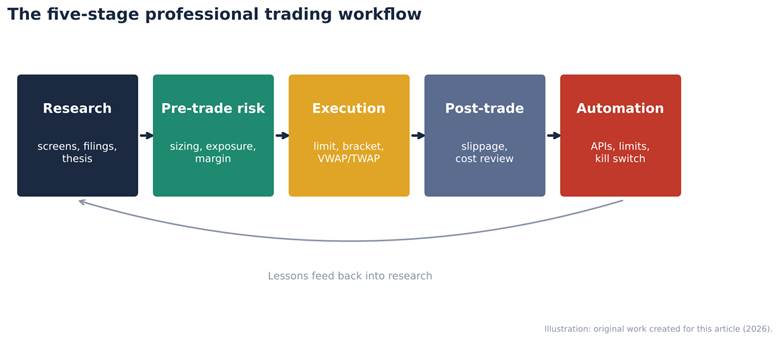
Figure: Diagram of the five-stage professional trading workflow from research to automation. Original illustration created for this article.
Professional Trading Workflows: How Advanced Investors Build an Execution, Risk and Automation Stack
Short answer: Professional investors do not rely on a single platform feature; they build a workflow with five linked stages: research, pre-trade risk checks, execution, post-trade review and automation. The platform is the hub, but the edge comes from consistent processes such as sizing every position against a risk budget, using execution algorithms for larger orders, and measuring slippage after every trade. Rule changes in 2026, including the replacement of the US pattern day trader rule with intraday margin standards and the full rollout of SEBI's retail algo framework, make a documented workflow more important than ever.
Our companion article compares advanced trading platforms feature by feature. This guide is different: it explains how to use those platforms within a professional-grade process.
Stage 1: Research and Idea Generation
A professional workflow begins with a defined universe and a repeatable screening process.
- Data sources: company filings (free on SEC EDGAR for US companies), exchange announcements, broker research and paid data terminals.
- Screens: valuation, quality, momentum or volatility filters that reduce thousands of securities to a manageable watchlist.
- Thesis documentation: every idea gets a written rationale, expected catalyst, target and invalidation level.
The output is not a trade; it is a shortlist of documented opportunities.
Stage 2: Pre-Trade Risk Controls
Before any order is placed, professionals answer three questions: how much can I lose, how does this trade change my portfolio, and is it permitted?
| Control | Purpose | Example rule |
| Position sizing | Limit loss per idea | Risk no more than 1% of capital between entry and stop |
| Exposure limits | Avoid concentration | Max 20% of portfolio in one sector |
| Margin check | Prevent forced liquidation | Keep projected margin use below a set threshold |
| Correlation check | Avoid hidden duplication | Flag new positions highly correlated with existing ones |
| Compliance check | Follow rules | Restricted lists, insider windows, regulatory limits |
Platforms such as Interactive Brokers' Trader Workstation provide real-time margin monitoring and scenario stress tests, so these checks can run before orders are sent rather than afterwards.
The 2026 US margin change
FINRA's pattern day trader designation and its $25,000 minimum were eliminated in 2026 after SEC approval of changes to FINRA Rule 4210. Brokers now apply a real-time intraday margin framework in which buying power updates throughout the day. E*TRADE, for instance, explains that an intraday margin deficit call can be issued if trading exceeds available intraday margin. Professionals should update their risk rules to reflect real-time margin rather than the old day-trade count.
Stage 3: Execution
Execution quality can add or subtract more than any commission saving, especially for larger orders.
Choosing the right order type
- Limit orders control price but risk non-execution.
- Bracket orders attach a profit target and stop-loss at entry.
- Conditional orders trigger only when another market condition is met.
Using execution algorithms
| Algorithm | How it works | When to use |
| VWAP | Spreads the order in line with expected volume through the day | Large orders where matching the day's average price is the goal |
| TWAP | Splits the order evenly across a set time window | Illiquid names or when volume forecasts are unreliable |
| Percentage of volume (POV) | Trades a set share of market volume | Building positions without dominating trading |
| Adaptive / smart routing | Seeks better prices across venues | Routine orders in liquid stocks |
IBKR lists VWAP, TWAP, POV and adaptive algorithms in TWS, and its Classic interface supports over 100 order types.
Stage 4: Post-Trade Review and Transaction Cost Analysis
After each trade, professionals compare the execution price against a benchmark such as the arrival price or the day's VWAP. The difference, called slippage, shows the true cost of trading.
A simple post-trade log should include:
1. Order time, size and type
2. Arrival price vs average fill price
3. Commissions and fees
4. Reason for entry and exit
5. Whether the trade followed the written plan
Reviewing this log monthly often reveals that a strategy's results depend as much on execution habits as on stock selection.
Stage 5: Automation and APIs
Automation reduces manual errors and enforces discipline, but it introduces technology risk.
- US: broker APIs, such as those offered by Interactive Brokers, allow custom order routing, alerts and portfolio rebalancing.
- India: SEBI's framework for retail algorithmic trading became fully applicable to all brokers on 1 April 2026. Algorithms using broker APIs must be registered with exchanges through the broker, and brokers that missed earlier milestones were barred from onboarding new retail API clients.
Essential safeguards include maximum order size limits, daily loss limits that stop the system, duplicate-order checks and a manual "kill switch".
Practical Example: Executing a Large Position
A fund manager wants to buy 200,000 shares of a mid-cap stock that trades about 2 million shares a day. Placing a single market order would likely push the price higher. Instead she:
1. Confirms the position fits a 3% portfolio weight and sector limits.
2. Runs a margin and stress-test check.
3. Uses a percentage-of-volume algorithm capped at 10% of market volume over two sessions.
4. Records the arrival price and compares the final average fill with it.
5. Logs the slippage and reviews whether the algorithm settings should change next time.
The result is a disciplined entry that limits market impact and creates data for future improvement.
Pros and Cons of a Formal Workflow
Pros
- Consistent decisions under pressure
- Lower execution costs and fewer errors
- Measurable performance by stage
- Easier compliance and audit trails
Cons
- Time-consuming to design and maintain
- Data, software and API costs add up
- Automation can fail in unexpected market conditions
- Over-engineering can slow decisions
Key Takeaways
- Treat the platform as a hub inside a five-stage workflow: research, pre-trade risk, execution, post-trade review and automation.
- Size positions from a risk budget, not conviction alone.
- Use execution algorithms for orders that are large relative to volume.
- Measure slippage after every trade.
- Update processes for 2026 rule changes: US intraday margin standards and SEBI's retail algo framework.
Frequently Asked Questions
What is a professional trading workflow?
It is a documented process linking research, pre-trade risk checks, execution, post-trade review and automation so that every trade follows consistent rules.
When should I use a VWAP order?
VWAP suits larger orders where you want to achieve roughly the day's volume-weighted average price and reduce market impact.
What replaced the pattern day trader rule?
In 2026, after SEC approval of FINRA Rule 4210 changes, brokers moved to a real-time intraday margin framework. The $25,000 PDT minimum no longer applies, but the $2,000 margin minimum does.
Is algorithmic trading legal for retail traders in India?
Yes, under SEBI's retail algo framework, fully applicable since 1 April 2026. Strategies using broker APIs must be registered with the exchanges through the broker.
What is transaction cost analysis?
It compares your execution prices with benchmarks such as arrival price or VWAP to measure slippage and the true cost of trading.
Financial Disclaimer
This article is for general information and education only and does not constitute investment, financial, legal or tax advice, or a recommendation to buy or sell any security. Investing in securities involves risk, including possible loss of principal. Fees, features, rankings and regulations cited were checked against the listed sources on 15 October 2026 and may change without notice. Verify current details with the provider or regulator and consider consulting a SEBI-registered investment adviser, a FINRA-registered professional or another qualified adviser before making financial decisions.
Source References
1. Interactive Brokers – Trader Workstation — https://www.interactivebrokers.com/en/trading/tws.php
2. E*TRADE – Pattern day trading rule change — https://us.etrade.com/knowledge/library/margin/pattern-day-trading-rule-change
3. Outlook Business – SEBI retail algo framework timeline — https://www.outlookbusiness.com/markets/sebi-extends-deadline-to-implement-retail-algo-trading-by-april-2026
4. SEBI circular (September 2025) — https://www.sebi.gov.in/sebi_data/attachdocs/sep-2025/1759232056254.pdf
5. SEC EDGAR – Search filings — https://www.sec.gov/search-filings
All sources were accessed on 15 October 2026.
Suggested Internal Links
| Anchor text | Suggested URL |
| Advanced Trading Platforms for Professional Investors (platform comparison) | /advanced-trading-platforms-professional-investors |
| Fundamental vs Technical Analysis Tools | /fundamental-vs-technical-analysis-tools |
| Paid vs Free Stock Research Services | /paid-vs-free-stock-research-services |